Ancient symbols for Outsiders,
Originals, and the Unclaimed
A heritage of rebellion, a history of metal
My Process
Idunna’s Tears is handmade jewelry cast and finished in rural Minnesota using traditional lost wax casting methods. Every piece begins as a carved original and passes through fire, burnout, casting, cleanup, and finishing by hand. By me.
So to begin with, the main technique I use is called lost wax casting. More specifically, lost wax investment casting or sometimes it’s called vacuum casting.
The process, in simplest terms, is this: You make the exact piece you want to end up with, out of wax or other combustible materials. Traditionally it was wax. Then you pour a hard mold around that piece and then place that hardened mold (with captive wax inside) into some sort of kiln. Then it goes through a range of temperatures from room temp to about 1200°F and back down again.
This is known as the burnout process, and after this, you have that same hardened shell, but the wax form inside has melted and turned to carbon smoke and dissipated away. Then molten metal is poured into the negative cavity where the wax was, and it fills that void.
From wax to metal
Then the object is quenched, at which time the hard shell dissolves away from thermal shock, and you’re left with a raw casting of the exact thing you made in wax, plus some sprue wires and possible fins that need to be cut off.
The object is placed in a solution called “pickle” and this removes the dull grey outer coating of oxidation leaving the metal silver.
Next comes a series of steps of grinding, sanding, polishing, and finishing to bring the luster and texture to a desired finish.
Finally, in most cases, prep, box, and ship to customer (or it’s ready for customer pickup or delivery)
Below are the steps in order with more details for those interested. There’s a few pictures to aid in digestion. They are all taken in my shop of works either made here or currently in process.
I hope you enjoy.
Ken
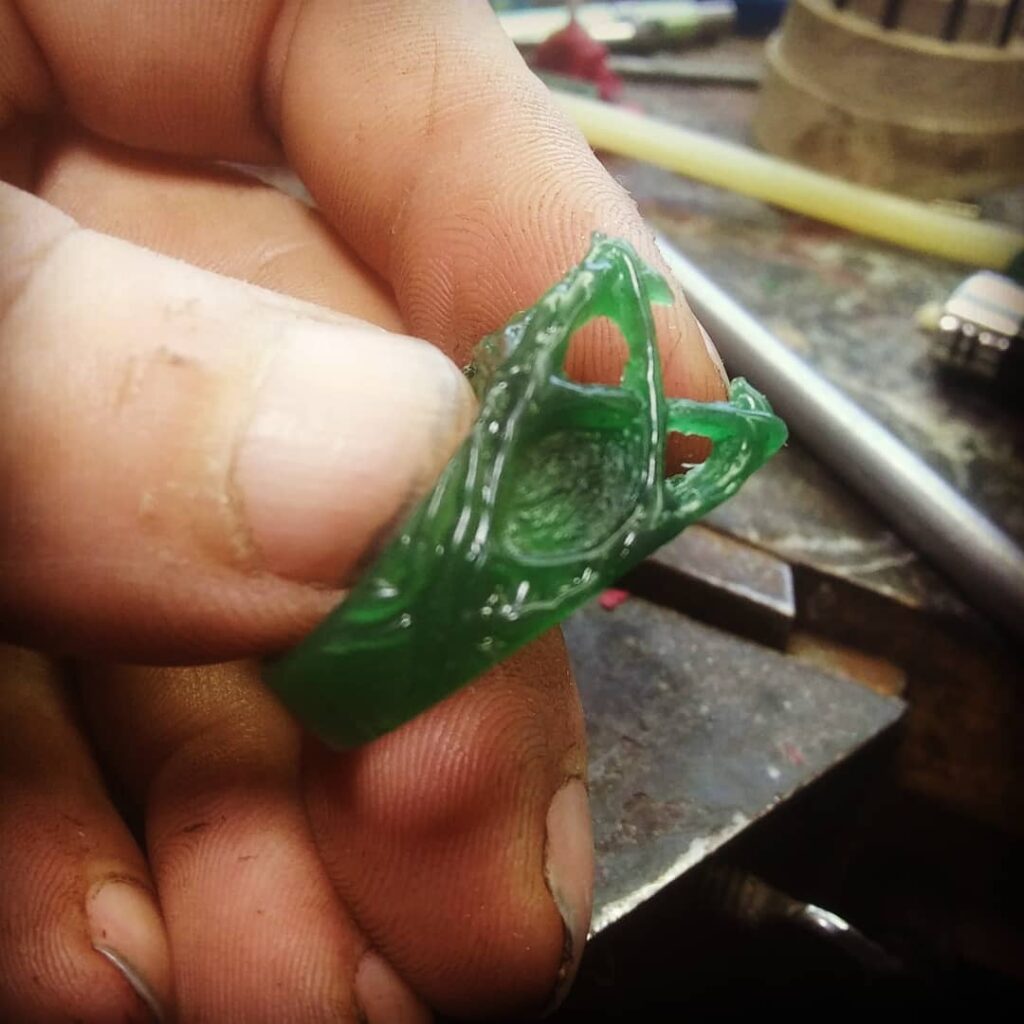
Wax Carving
Just about everything I make starts with a wax. I use micro-crystalline jeweler’s wax, a real hard wax. I print out my templates and trace them onto the wax, then carve with a variety of small micro hand carvers under magnifying optics. I hand carve basically every pattern, every ring, every piece I make. In one way or another, nearly everything starts as a hand-sculpted wax pattern.
Now, I have started 3D printing, and now and then I use it to help with a pattern. I haven’t turned into a 3D printing production house for jewelry. It accentuates my work, it doesn’t replace it. Most of what I make is still carved by hand in wax.
Sprues
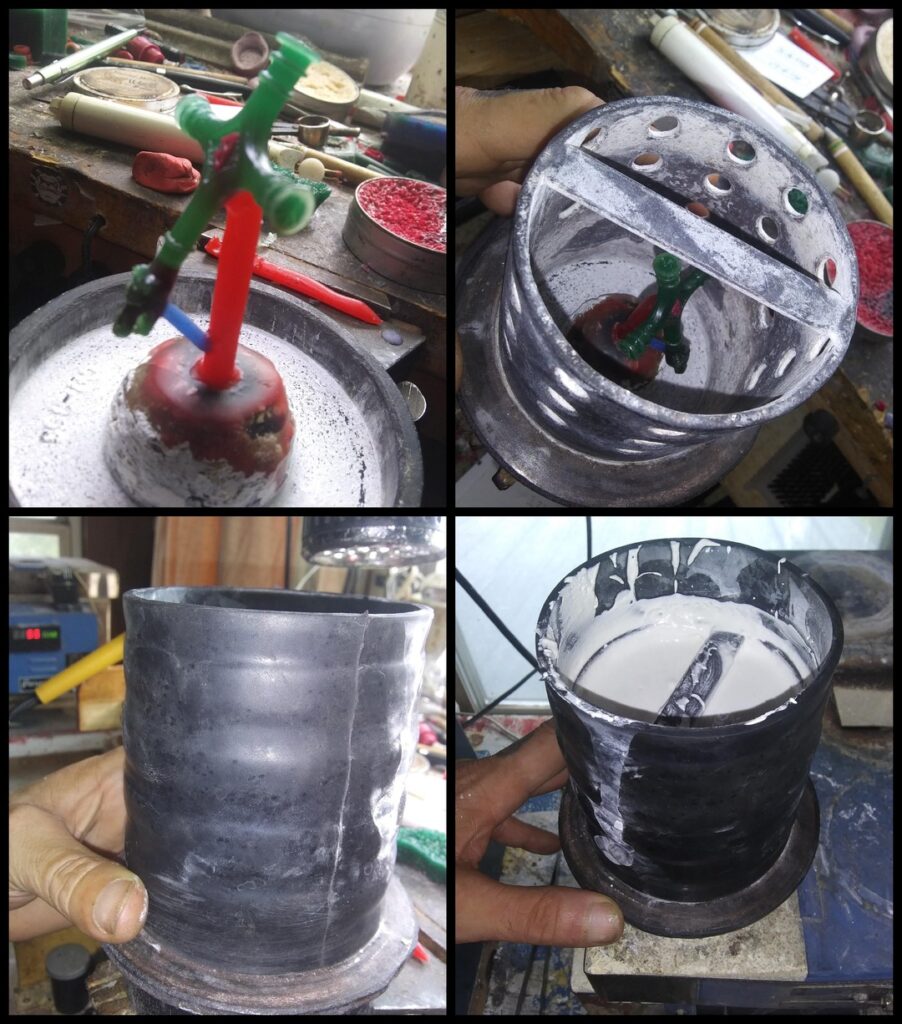
Then comes the spruing. Spruing is the art of using a series of wax wires of different diameters to determine the path the metal is going to take in order to fill the pattern. The idea is to create a controlled flow with low turbulence, but you also have to take into account shrinkage and expansion in both the pattern and the metal. There is a definite art to this step.
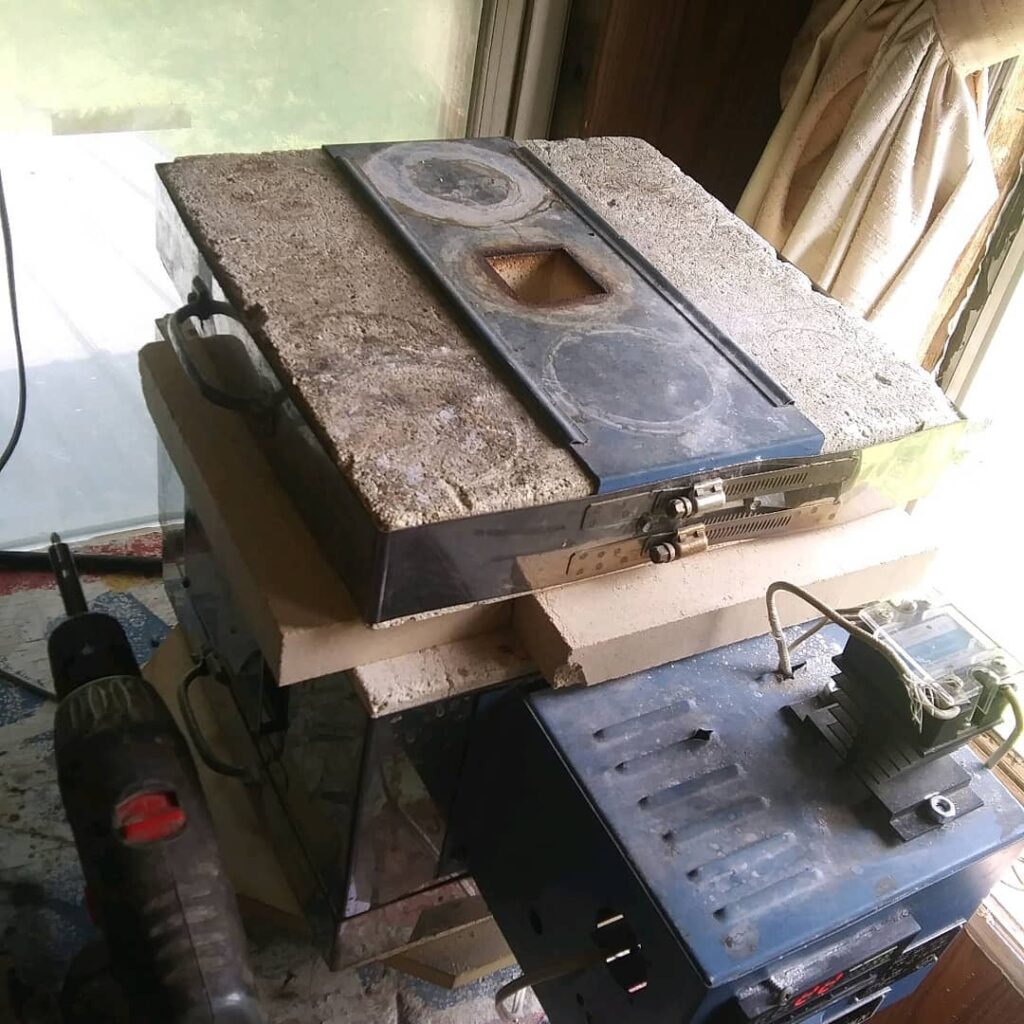
Investment/Burnout
After spruing, the pattern gets mounted on a rubber base. A perforated can called a flask is placed around it, and the holes in the flask get taped over to plug them. Next, a slurry of what’s called investment is made. It’s a powder mixed with water that dries to a hard, ceramic-like shell around the wax pattern. It’s then set somewhere stable for a few hours to dry.
Once the mold has set and hardened, the tape is pulled off and the flask is placed in a hot kiln. It’s taken through a range of temperatures, starting around 300 degrees and climbing to about 1300, and it sits at each one for a different amount of time, with the total burnout process taking between 12 and 14 hours. This melts the wax and lets it run out, and then the leftover residue burns out as carbon vapor. Then the temperature is brought back down to 950 degrees, where the flask sits for a few hours to make sure it’s that temperature all the way through the core.
At that point you have a mold with a negative cavity inside it where the wax used to be, vacated by the heat. That cavity is where the silver will go. Next, the flask is pulled out, flipped upside down, and ready to pour.
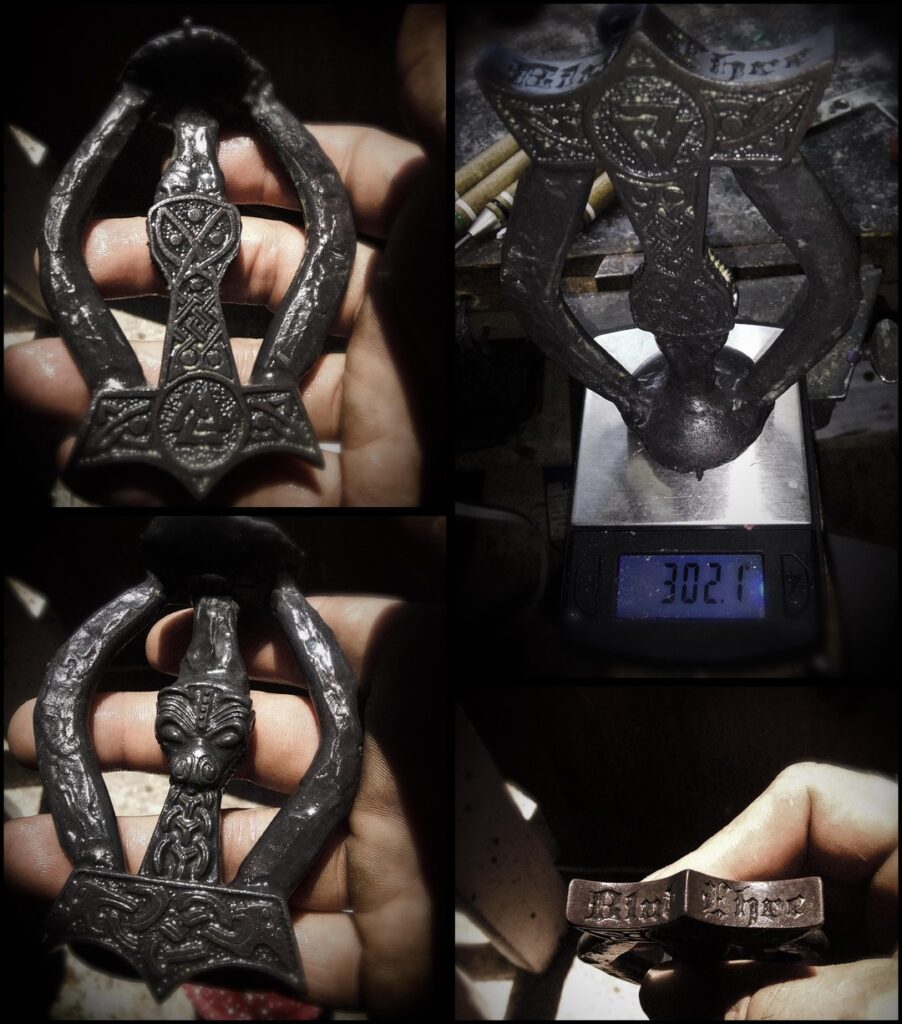
Pouring Metal
After the metal is poured, I let the flask sit until the color comes off the button, until the red dies down to a shiny gray. Then I grab it with my tongs and slowly lower it into a bucket of room temperature water. The heat of the mold sends it into thermal shock, and it tears itself apart. When it’s all done, what you have left is the raw casting in a wet sludge of melted-away mold material.
Raw Casting
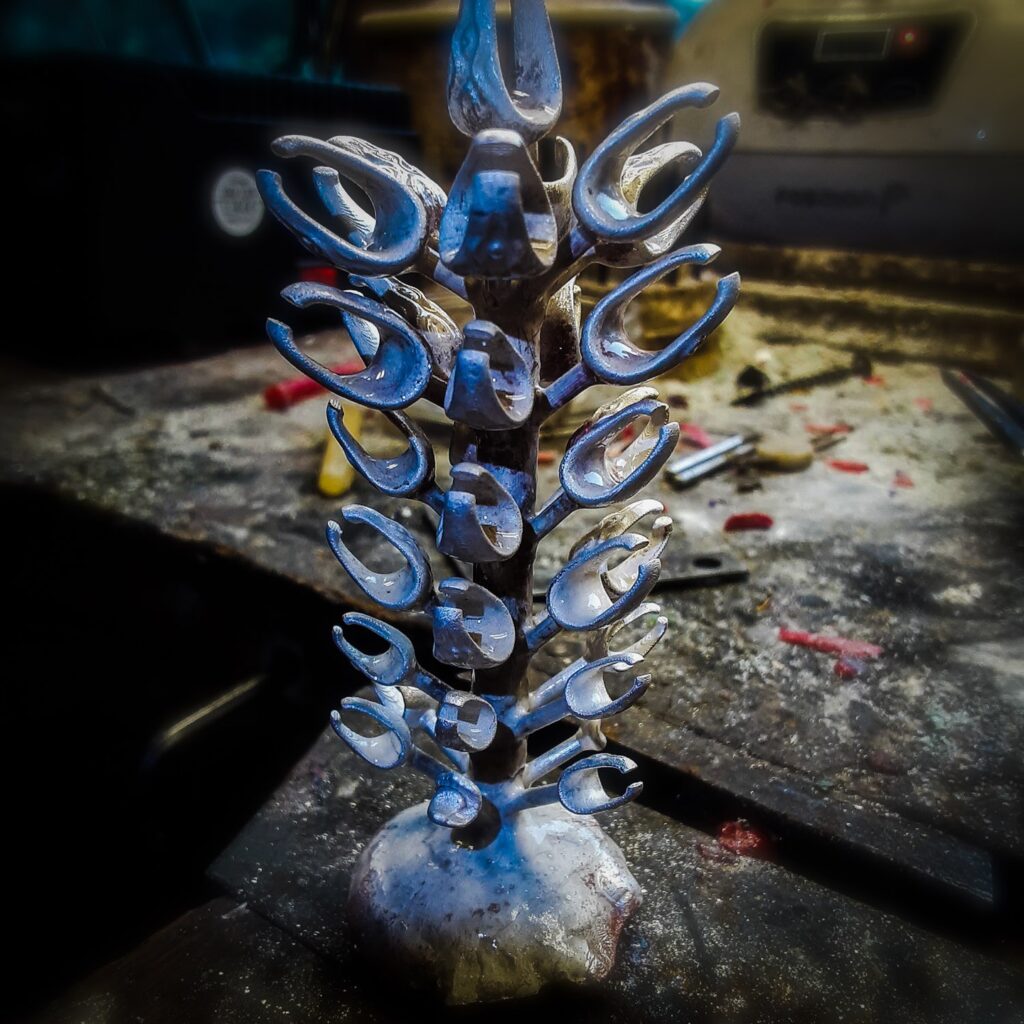
After the piece is removed from the quench bucket, I use a variety of cutters, files, and saws to remove it from the sprues and take down any remaining sprue buttons or lumps on the piece. Once the piece has been roughed out to my satisfaction, it’s ready for the final step, finishing and polishing.
Cleanup/Finishing
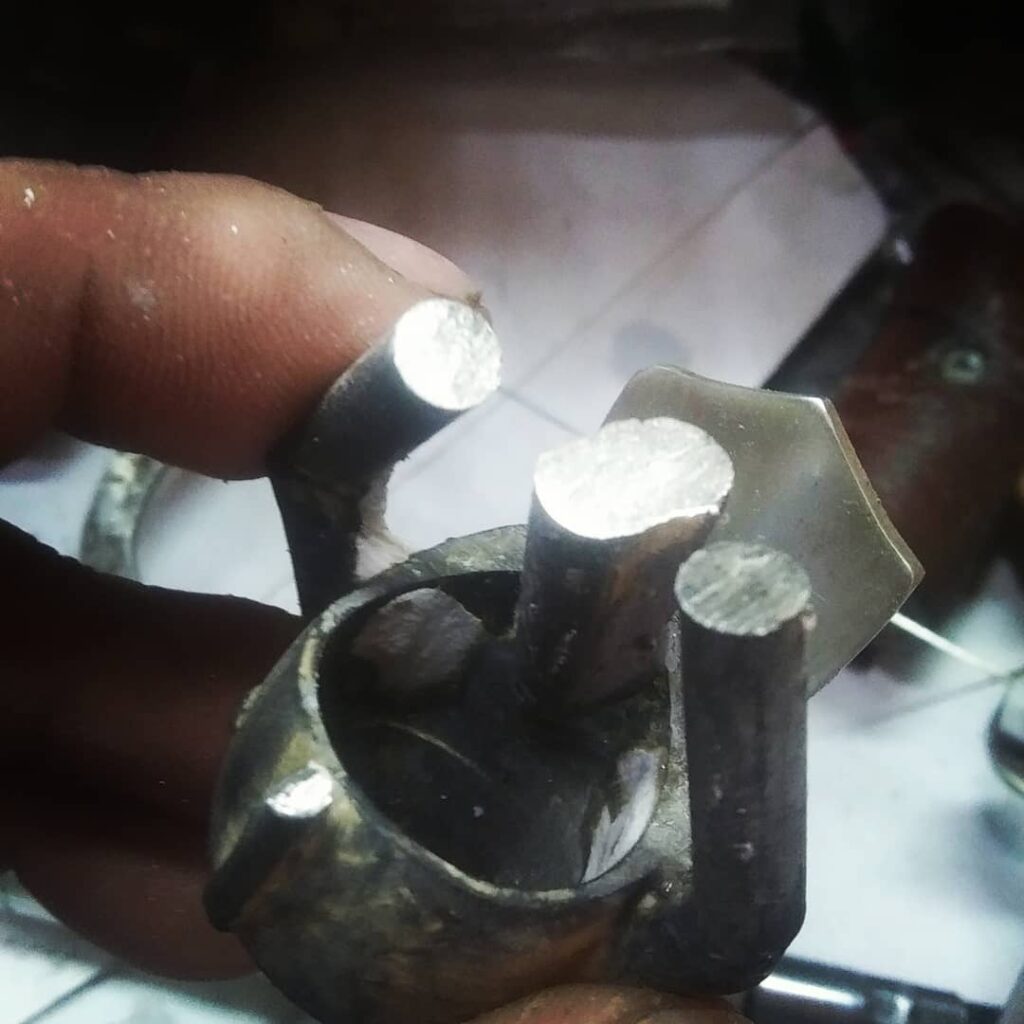
The finishing and polishing is possibly the most tedious part. It’s a process of sanding, filing, and more sanding, then a series of fine grits on a buffing wheel, working from coarse to medium. Typically I then put the piece in a rotary tumbler with regular stainless steel shot for final burnishing and polishing. After that it goes over the polishing wheels again with the fine grits.
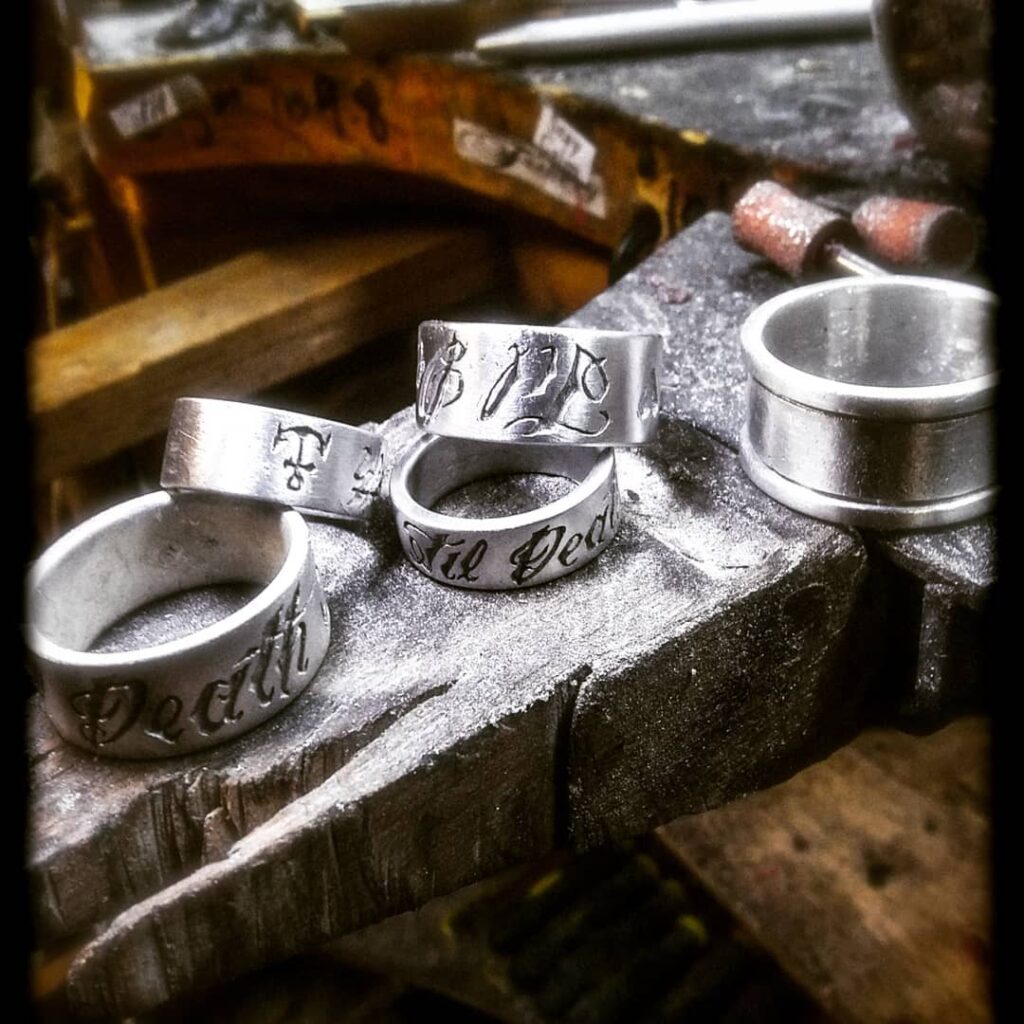
Once the piece has been brought to the desired luster, I use liver of sulfur to oxidize the low spots black. After the oxidation, I hit it one last time with a very high grit polish to bring the luster back. That takes the black off the high spots and leaves it in the low spots, which creates a nice contrast and makes the black pop, and the piece is done!
Shipping
The finished ring is placed in a small ring box. I wrap the box in bubble wrap or some other shock-absorbing material and put it in a slightly larger box. Then I print my shipping label, apply it, and off it goes to the mailbox. The ring is on its way to its new home.